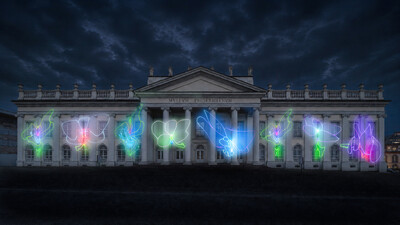
- Fridericianum
British artist Matt Copson has designed the site-specific work Flowers (2026) specially for this year’s Kassel Museum Night. The temporary intervention consists of eight colorful laser projections illuminating the entire exterior facade of the Fridericianum. Using projectors typically found in clubs and stage productions, animated flowers bloom, wilt, and dissolve into abstraction in a constant loop. Together, their amorphous forms transform the building into an artificial landscape as the lasers continuously redraw lines of light through the darkness. The projection will be accompanied by an ambient score composed and performed live by British-Polish artist felicita, adding an auditory dimension to the installation.
9–9.30 pm
Artist talk with Matt Copson
The talk with Matt Copson and Luise von Nobbe (Curator, Fridericianum) takes place as an introduction to the premiere of Flowers (2026). The conversation offers insight into the creation process of the work and discusses artistic references, sources of inspiration, and effects of the installation.
Function Room Fridericianum, entry only with a Kassler Museumsnacht ticket
9.45–10 pm
Grand opening of the intervention Flowers by Matt Copson
In front of the Fridericianum, free admission
10 pm–1 am
Matt Copson: Flowers
In front of the Fridericianum, free admission
While Copson’s works have previously been conceived primarily for exhibition spaces and other enclosed areas, Kassel marks the first time the artist realizes a large-scale laser projection outdoors. The natural darkness of the surroundings not only evokes a sense of mystery and boundlessness, it also forms an integral part of the artwork by turning the facade into a suitable projection surface. The building’s architectural elements—such as windows, cornices, and columns—remain faintly recognizable behind the laser-generated imagery, anchoring the work to the specific site of its presentation.
The eight animated flowers, projected in a row from Friedrichsplatz onto the Kunsthalle, can be described as ephemeral light sculptures. They exist in a state of perpetual transformation. The cycle presented, from the blossoming to the withering of the plants, can be interpreted as a vanitas motif—a reminder of the transience of all earthly things. With Flowers, Copson explores the existential question of meaning in the face of life’s finitude and a cyclical understanding of time, making ambivalent the flowers’ symbolic power as emblems of beauty, growth, and renewal. The monumental scale of the projection reinforces the impression of an almost uncanny presence of the plants: Far from being a depiction of nature, they appear as autonomous phenomena brought to life.
By using laser beams as an artistic medium in Kassel’s urban environment—particularly in relation to the Fridericianum—Flowers enters into a formal dialogue with Horst H. Baumann’s work Laserscape (1977), created for documenta 6. Permanently installed in the Zwehrenturm of the Fridericianum, Laserscape connects the Kunsthalle to three Kassel landmarks today—the Orangerie, the Hessian State Museum, and the Hercules monument in Bergpark Wilhelmshöhe—through geometrically arranged lines of light. While Baumann establishes spatial relationships between these monuments through laser beams and visually structures the urban space, Copson overlays the neoclassical architecture of the Fridericianum with his animated imagery, evoking a sense of magic.
In its use of the Fridericianum’s exterior facade as a projection surface, Flowers builds on the film installation Hope (2020) by Trisha Baga, which was also projected onto the building. Other site-specific outdoor projects and temporary interventions by the Kunsthalle in recent years include 7000 Palmen by Cosima von Bonin (2025), Kermit the Frog, Even by Alex Da Corte (2024), and Top down / Bottom up by Alexandra Bircken (2020).
Copson was born in 1992 in Oxford, England, and currently lives and works in London. He has presented solo exhibitions and realized projects at institutions that include the Sandretto Re Rebaudengo Foundation in Venice (2026); the KW Institute for Contemporary Art in Berlin (2025); the LUMA Foundation in Zurich (2025); the Aspen Art Museum in Aspen, Colorado, USA (2023); the Swiss Institute in New York (2019); the Fondation Louis Vuitton in Paris (2018); the Mönchehaus Museum in Goslar (2018); and the Serpentine Galleries in London (2016). Together with Oliver Leith, he created the opera Last Days, which premiered in 2022 at the Royal Opera House in London.