- Fridericianum
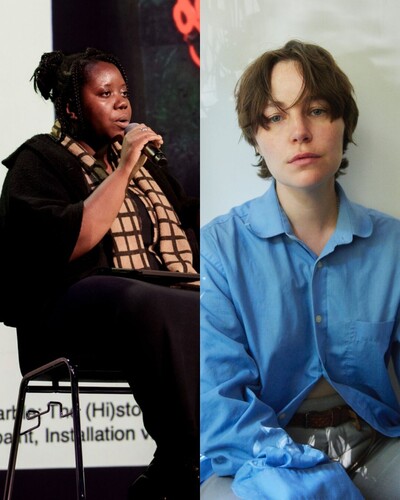
With Christina Maria Ruederer and Jeanne-Ange Wagne
On the occasion of Catherine Opie’s exhibition The Pause That Dreams Against Erasure, Jeanne-Ange Wagne and Christina Maria Ruederer explore contemporary queer perspectives in the visual arts, with particular attention to lesbian positions. Through a shared dialogue, they offer insights into artistic practices in which “queering” becomes visible in a variety of ways.
In this context, queering is understood not only in relation to gender diversity or sexual identities, but also as a subversive practice. It challenges social norms and structures, deconstructs dominant systems of knowledge, and critiques processes of canonization as well as the prevailing voices within art history.
Queer-feminist and lesbian perspectives of African, Afro-diasporic, and Black artists play a significant role in shaping global and institutionalized art discourse. Nevertheless, these positions still too often exist within a tension between hypervisibility and invisibility, as well as under the pressure to serve the demands of representative visibility. Art historian Kobena Mercer refers to this phenomenon as “the burden of representation.”
Within this framework, the keynote lecture examines the visual languages and thematic concerns of emerging and established artists whose works continue the traditions of the “Black School of Thought” through a queering lens. At the same time, it highlights the cultural significance and social relevance of their practices.
Within an art history that has been structured for centuries by heteronormative and Western frameworks, the question of the institutionalization of queer practice also arises: Is canonization desirable at all, or does it contradict the very premise of queering? Or can critical engagement with institutions open up new spaces for thought and action?
Queering can be understood as a method that disrupts existing structures; considers social categories such as class, race, and gender in an intersectional manner; and always understands questions of visibility as questions of power. Against this background, the central question remains: How can queer art be read today—and what does it mean to label it as such in the first place?
Christina Maria Ruederer is an art historian and film scholar. She works as a curator at the intersection of visual art and film and is particularly interested in transdisciplinary and collaborative formats in the fields of memory and trauma studies, archival work, and pop and digital cultures.
As a curator, she has organized numerous exhibitions, live programs, reading groups, and publications, including at the Kunstverein München, Lothringer 13 Halle, at Museum Villa Stuck, the Munich Film Festival (2023), and the Schinkel Pavillon in Berlin. Her writings have appeared in art publications and magazines such as Texte zur Kunst and Das Wetter. Since 2025, she has also been part of the leadership team at the queer-lesbian archive Spinnboden, in Berlin.
Jeanne-Ange Wagne is an art historian who works as a coordinator, language mediator, and educator. Through her artistic and research-based practice, she explores memory, preservation, and Africa’s unlawfully displaced material heritage in European museums. In addition, she examines the cultural studies framework for understanding developments and trends in the visual arts, pop culture, music, and fashion.
She regularly designs and facilitates critical educational programs, artistic interventions, and lectures, and publishes articles for cultural and art institutions in Germany and abroad, most recently for the Academy of Arts Berlin, the Kestner Gesellschaft in Hanover, c/o Berlin, Creamcake Berlin, the Goethe-Institut Cameroon in collaboration with the Musée National Yaoundé, SAVVY Contemporary, and the Brücke Museum, among others.
Until October 2023, she worked for the German branch of the transnational research project The Restitution of Knowledge, which was based in the Department of Modern Art History at the Technical University of Berlin under the direction of art historian Prof. Dr. Bénédicte Savoy. As part of this project, she curated and coordinated the event series KuK-Tuesdays: Dislocation from 2022 to 2023.
Admission is free.
No registration is required.