- documenta
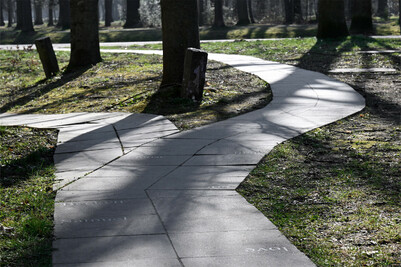
Scottish artist David Harding died on February 21. His contribution to documenta 14 (2017), the subtle intervention Desire Lines, has been retained by the city of Kassel as a permanent installation: from the park path along the Küchengraben, a poetic path branches off to the grounds of the art academy. Embedded in the concrete slabs of this path is a bronze inscription quoting from Samuel Beckett’s love poem “Cascando” (1936):
„If you do not love me I shall not be loved /
If I do not love you I shall not love.“
„Liebst du mich nicht, so werd ich nicht geliebt /
Lieb ich nicht dich, so werde ich nicht lieben.“
As head of the Environmental Art program at the Glasgow School of Art, Harding influenced generations of younger artists.
In the following letter, Adam Szymczyk, artistic director of documenta 14, remembers David Harding, the influential artist, teacher, and committed advocate of socially oriented art:
Dear Friends and Colleagues,
You might have heard or read the sad news by now. David Harding passed on February 21. He was born in Leith, Scotland, on March 3, 1937.
David was an amazing human being, a great artist, a teacher and friend to many.
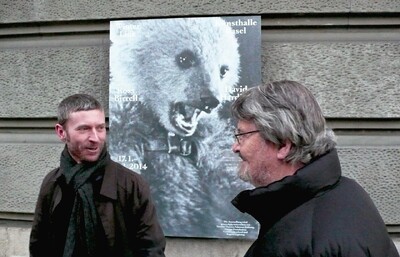
We first met in 2006 when he and Ross Birrell screened their new film (and the first collaborative piece in the line of works in various media and formats they realized together during the following twenty years) “Port Bou: 18 Fragments for Walter Benjamin” at Stadtkino Basel. I invited them following a suggestion I received back then from Gustav Metzger when he had his exhibition “In Memoriam: New Works” at the Kunsthalle. Harding and Birrell had mentioned the film to Metzger (whom Birrell had known for some years) when they met at the 2005 opening of an exhibition at Tate Britain of works by John Latham, who was an old friend of Harding’s. The lineage behind the conviction that art has an active role to play in society is meaningful and extends well back into the past century: it was Metzger who invited Latham to DIAS (Destruction in Art Symposium) at Africa Centre in London in September 1966.
Later in 2006, Birrell and Harding participated in the show “Quauhnahuac: The Straight Line Is a Utopia” at Kunsthalle Basel, for which they realized a video “Cuernavaca: A Journey in Search of Malcolm Lowry” and a site-specific text mural in Cuernavaca with the Mexican artist, Cisco Jiménez. We worked together next in “Strange Comfort Afforded by the Profession,” two related exhibitions at the Istituto Svizzero in Rome and Kunsthalle Basel, which I curated with Salvatore Lacagnina in 2010. Birrell and Harding presented a two-channel video featuring the popular song “Guantanamera” based on lyrics by the Cuban national poet and revolutionary José Martí, performed by José Andrés Ramírez (Guantanamo) and Renee Barrios (Miami), and playing simultaneously. We met again, at Museo Tamayo in Mexico City in 2012, in the exhibition “Olinka, or Where Movement Is Created”. Two years later, both artists held their expansive exhibition “Winter Line” at the Kunsthalle Basel (see https://www.academia.edu/34410408/Sense_and_Sensibility_Ross_Birrell_and_David_Harding_Terpentin).
In documenta 14, you will all remember David Harding’s poetry path “If you do not love me…” from Samuel Beckett’s poem “Cascando”, made of concrete slabs with bronze letters at Rizari Park in Athens, where it still is, and Desire Lines with the Beckett poem quote in German, outside the Kunsthochschule in Kassel. Also at documenta 14, Birrell and Harding invited the Syrian Expat Philharmonic Orchestra to perform Henryk Górecki’s “Symphony No. 3: Symphony of Sorrowful Songs” together with Athens State Orchestra, at Megaron Mousikis in Athens. A three-channel video work “Lento,” built around the first movement of that sorrowful symphony, was presented in documenta 14 in Kassel at Palais Bellevue.
In 2021, Harding produced a permanent public work on the landing before the entrance to the new building of the Criminal Investigation Unit of Zurich City Police: the words “Audiatur et altera pars” (Let the Other Side Be Heard As Well)—made of letters cast in copper and inlaid in concrete—address all those who enter the building in Latin, as well as in German, French, Italian and Romansh—the four official languages of Switzerland. Harding commented: “As a general principle of rationality in reaching conclusions in disputed matters, “Hear both sides” was treated as part of common wisdom by the Ancient Greek dramatists. [e.g. Aeschylus, “The Eumenides” 431, 435]”.
And finally, last year, Birrell and Harding’s “Dante Desire Line Poetry Path” with a quote from Dante Alighieri’s “La Vita Nuova” on universal forgiveness and love, was realized at Villa Borghese Gardens in Rome, as part of the public art project Lavinia, curated by Salvatore Lacagnina.
Instead of writing a paean praising a great poet that David was, I take the liberty to quote in extenso Ross Birrell’s accurate and experience-based note on David Harding, published in documenta 14 Daybook:
When Douglas Gordon was asked what he had been taught during his time as a student of the Environmental Art course—the influential department at Glasgow School of Art established by David Harding in 1985—his reply was, “To sing. Not how to sing but simply to sing.” This enigmatic description of the department’s ethos, combined with the global reputation of its graduates, suggest that Environmental Art was less a course than a school within a school. Harding, a committed artist-teacher, born in Edinburgh in 1937, perhaps epitomized Wassily Kandinsky’s image of the artist “who cannot see his life’s purpose in an art without aims.” But whereas Kandinsky was motivated by the spiritual affects of colour, Harding was mobilized by the material conditions of context, and his output has been characterized not by abstract impressions and improvisations in pictorial form, but by direct interventions in the concrete world of the built environment.
Harding’s perspective upon art, and his approach to its teaching, was influenced by his commitment to social justice and his association with the Artist Placement Group, conceived by Barbara Steveni in 1965 and founded in collaboration with John Latham in 1966, whose manifesto began, “The context is half the work”—a mantra which would later become a mandate for students of the Environmental Art department. Prior to setting up the course in Glasgow, Harding had spent four years at a college in Lafia, central Nigeria, working with his students on the development of a local art practice, before taking up, in 1968, the position of “Town Artist” in the Scottish New Town of Glenrothes. When describing the approach to making art in the context of a new town, as well as the production of works made in consultation and collaboration with residents—a practice which contributed to the development of what became known as “new genre public art”—we find the word “orchestrate.” To orchestrate is not simply to arrange or to shape but to listen, to be open to others, to celebrate the potential harmony and dissonance of cultural difference. This musical term also recalls us to the importance of singing for Harding, the keynote that resounds throughout the social, political, and pedagogical dimensions of his practice. At its most vital level, the singing voice testifies to the resilience of the human heart and of the spirit. And it is singing that has resonated throughout Harding’s approach to art, teaching, and to life. As Rainer Maria Rilke wrote in Sonnets to Orpheus: “Gesang ist Dasein.” Singing is being.
—Ross Birrell
For David, who was trained as a sculptor, the context in public art was not about an abstract idea, but about a real situation and the work that needed to be done: an artist and art installation specialist Paul Embleton quotes his remark: “Context is half the work, but if you don’t do the work then context means fuck all.”
And, I quote David’s own words too, from his text “On Singing,” recounting the experience of his leading the Environmental Art course at the Glasgow School of Arts (you will find Harding’s entire text, and his other brilliant pieces of writing, on the website www.davidharding.net):
“I have been asked on many occasions what we actually taught the students in the Environmental Art department at Glasgow School of Art. I usually replied, half in jest and tongue in cheek, ‘singing,’ and proceeded to quote a short three-line poem by Adrian Mitchell in which I’d changed only one word – ‘singing’ instead of ‘poetry’- but the meaning remains the same:
Letter to a politician.
I have read your manifesto with great interest
But it says nothing about singing.
(…)
Douglas Gordon’s comment that he was taught, ‘To sing. Not how to sing, but simply TO sing’ described a prevailing attitude in the department. Not everyone of course can, or feels inclined, to actually sing publicly in company, but I learned from my family upbringing, and in successive other situations, the value of a few drinks and a ‘sing-song’ in forging a close and friendly social setting. Where there is mutual and supporting respect for the efforts of the individual, a confidence is bred in which people do perform whether it be a song, a poem, a story, whatever takes their fancy. That for me is singing. As the poet Shelley said, ‘social enjoyment in one form or another is the alpha and omega of existence.”
I am sad, but I hope David’s voice - his spirited presence, enthusiasm and realism, singing and sense of humour - will withstand the ravages of time, lifting us up in whatever is yet to come.
Sursum Corda!
Sincerely Yours,
Adam