- documenta
- Fridericianum
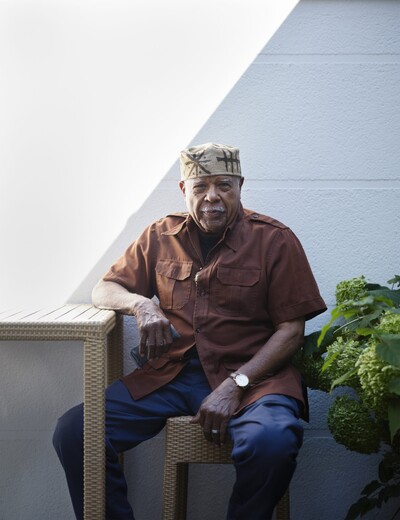
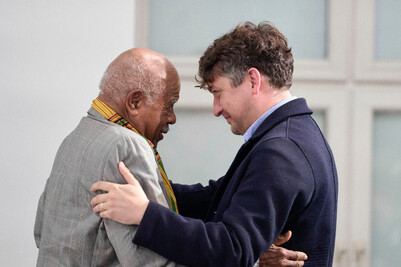
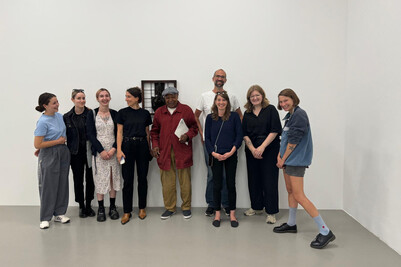
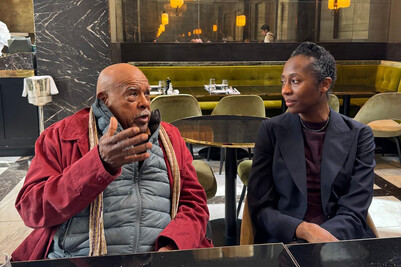
It is with great sadness that we have learned of the passing of Melvin Edwards. Just a few months ago, on the occasion of the retrospective Some Bright Morning curated by Luise von Nobbe and Moritz Wesseler at the Fridericianum, we had the opportunity to experience him as an impressive artistic personality and got to know him as an open and extremely approachable person. His warmth moved us—and everyone who encountered him in Kassel during those days—and touched us deeply.
In his sculptural and graphic work, Melvin Edwards moved for decades along the boundary between abstraction and figuration. With great sensitivity, his welded sculptures and reliefs made of steel and scrap metal—including the famous series Lynch Fragments, begun in 1963—reflect the long and devastating history of violence against the Black population in the United States. From machine parts, locks, tools, and iron chains emerge ciphers of human bodies and evocations of suffering of particular physical intensity—abstract assemblages that simultaneously embody sensuality, humanity, and dignity.
In 1970, the Whitney Museum dedicated its first solo exhibition to Melvin Edwards—a milestone in his career and an honor bestowed upon him as the first African American artist in a predominantly white art world. That same year, he began his travels to Africa, which he continued until the end of his career. In addition to his studios in Plainview, New Jersey, and Accord, New York, which he used until the end, the Senegalese capital of Dakar became a central location for his work and artistic inspiration from that point on.
In addition to Okwui Enwezor, Melvin Edwards also collaborated closely with Naomi Beckwith. During his tenure as director at the Haus der Kunst in Munich, Enwezor presented a selection of Edwards’ steel sculptures as part of the exhibition Postwar: Art Between the Pacific and the Atlantic, 1945–1965 (2016/2017). Edwards also played a central role in Enwezor’s legacy—the exhibition Grief and Grievance: Art and Mourning in America (2021) at New York’s New Museum, which he conceived and which Beckwith completed after his death. Finally, last year, the Kassel retrospective was also on view in Paris in a show adapted by Beckwith for the Palais de Tokyo.
Moritz Wesseler, Director Fridericianum:
“We mourn the loss of Melvin Edwards, with whom we had a close working relationship. Through a trusting and warm dialogue, and with great passion, he worked together with the Fridericianum team to develop his first comprehensive retrospective in Europe, which toured from Kassel to the Kunsthalle Bern and on to the Palais de Tokyo in Paris. Through groups of works such as the Lynch Fragments, the exhibition made it possible to experience firsthand how Edwards, with his abstract-minimalist formal language, gave powerful and moving expression to experiences of racial violence as well as the resistance of African Americans in the United States. It is with deep gratitude that we bid farewell to an influential yet approachable artist and friend.”
Naomi Beckwith, Artistic Director documenta 16
“I am utterly saddened by the passing of Melvin Edwards, who was, til the very end of his life, full of ideas and energy. Edwards will be remembered for works that sublimated industrial detritus into forms that reminded society of our capacity for cruelty and division. But he should be remembered, equally, for his ability to make those same objects tender, musical, and wondrous and for his commitment, as a global-minded artist, to freedom through and with the arts.”
Andreas Hoffmann, Managing Director of documenta and Museum Fridericianum gGmbH:
“With Melvin Edwards, we are losing an outstanding artist and a wonderful person. It was a great honor for us to be able to present him in the Fridericianum’s program. The fact that the artistic direction of documenta 16 included the Kassel exhibition in its ‘American Season’ at the Palais de Tokyo in Paris demonstrates how institutional connections based on recognition and friendship can have an international impact.”