- documenta
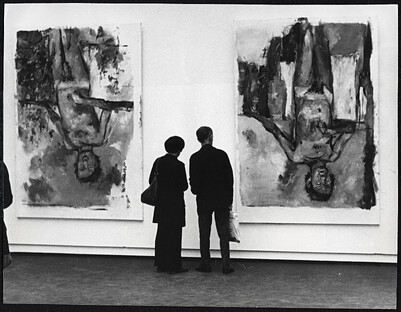
“The problem is not the object in the picture, but the picture as an object.”
(Georg Baselitz)
On April 30, the painter and sculptor Georg Baselitz died at the age of 88. With his images of an upside-down world, he was among the most internationally successful German artists.
Born in 1938 as Hans-Georg Kern in Deutschbaselitz (Upper Lusatia, Saxony), he began studying in 1956 at the East Berlin Academy of Art Weißensee under Walter Womacka (1925–2010). After just two semesters, he was expelled for ideological unreliability and “social immaturity” and moved to West Berlin to study at the Academy of Fine Arts—now the UdK—under Hann Trier (1915–1999), an important representative of Informel and a multiple participant in documenta.
Under the artist name Georg Baselitz, he and Eugen Schönebeck proclaimed a departure from abstraction in the “Pandemonic Manifestos,” before a—carefully calculated—art scandal propelled him into the public eye under the label of obscenity: his first solo exhibition in Berlin in 1963 ended with the police confiscation of two works deemed pornographic. The court case surrounding “The Big Night Down the Drain” and “Naked Man” made headlines across West Germany and was closely followed, with reference to the “freedom of art,” even in the Hessische Allgemeine newspaper in Kassel.
From 1972 onward, Baselitz was regularly invited to documenta in Kassel. Harald Szeemann, Manfred Schneckenburger, and Rudi Fuchs supported his large-scale, expressive painting, whose characteristic inversion of motifs marks a distinctive middle path between figuration and abstraction. A brief scandal arose when his paintings were withdrawn on the opening day of documenta 6 (1977). Like Markus Lüpertz and A.R. Penck, he refused to be exhibited alongside “state artists” from the GDR.
In 1980, Baselitz reinvented himself once again: in the German Pavilion, he presented a monumental wooden sculpture for the first time (“Model for a Sculpture,” 1980). Using an axe and chainsaw, he shaped tree trunks into painted figures, which became a permanent part of his work.
The biographically rooted confrontation with the traumas of German history, with national symbols, and with the Nazi past played a central role in his work from the 1960s and 1970s onward.
During the chancellorship of Gerhard Schröder, the gestural “Finger Painting / Eagle Score” (1972)—an eagle gliding upside down against a sky-blue background—became a hallmark of the country’s political iconography.
Baselitz received international recognition through numerous awards and honors, including the Goslarer Kaiserring (1981) and the Praemium Imperiale of the Japan Art Association (2004), one of the world’s most prestigious awards in the field of visual arts.