- documenta
- documenta archiv
“I am a typical Italian artist. Like the Futurists, I seek wholeness and try to penetrate everything. What I aspire to is ‘Arte Totale,’ a kind of Wagnerian Gesamtkunstwerk.”
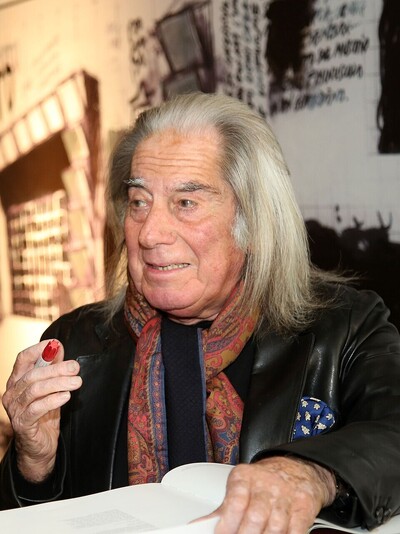
Italian video and installation artist Fabrizio Plessi never shied away from grand gestures and even grander scales. He made his international breakthrough in 1987 when, for documenta 8, he brought the Tiber from Rome to Kassel and had it flow virtually through the Apollo Hall of the Orangerie. Last Sunday, Plessi died at the age of 86 not far from Venice—the city that shaped him as a student at the Accademia di Belle Arti there and gave him the leitmotif of his artistic work: the element of water.
“For me, water has a metaphorical quality. It is the epitome of movement, a source of energy, and a means of transport for the most diverse substances and objects. The same applies to video for me. It is a means of transporting ideas.”
His career began with performances and actions that sometimes had a neo-Dadaist character: Plessi confined water to cages, divided rivers and lakes with a handsaw, and used a hammer and nail to punch invisible geometric marks into the waters of a river. In keeping with Claes Oldenburg’s motto Objects into Monuments, he also devised an artistic rescue plan to combat flooding in Venice: Spugna D’Emergenza (1970), a system envisioned in photo collages consisting of monumental floating sponge sculptures designed to counteract the acqua alta through suction and, in an emergency, to drain the lagoon. This period also saw his collaboration with sound artist and later documenta participant Christina Kubisch, including the video performance Liquid Piece (1975), a piece for flute and 250 glasses of water.
Starting in the 1980s, video and installation came to the forefront—the cycles of water in Plessi’s “Spectacle of the Elements” now flowed in virtual whirlpools of light across the screens of increasingly expansive mixed-media installations characterized by the material aesthetics of Arte Povera. It was only natural that atmospherically striking stage designs for opera and theater became another artistic strand of his work.
The room installation Roma, conceived specifically for Manfred Schneckerburger’s documenta 8—which later gave rise to a series of works on international metropolises—became one of his key works. In Kassel, he transformed the central hall of the Orangerie into a perpetual motion machine of history. He bathed the walls in Pompeian red and, using 36 monitors lying on their backs and framed by white-gray travertine slabs, traced the open circular shape of the Baroque St. Peter’s Square in the Vatican. The blue waves of the electronically animated Tiber flickered across the screens, while a conveyor belt sent imaginary boulders—symbolizing the rise and fall of the Eternal City—plunging into the virtual waters at regular intervals.
Fabrizio Plessi was a recurring guest at the Venice Biennale for decades, exhibited at the São Paulo Biennial, and created Mare Verticale, a 44-meter-tall architecture-integrated video installation for the Italian Pavilion at Expo 2000 in Hanover. From 1990 to 2000, he held the chair for “Humanization of Technologies and Electronic Scenography” at the Cologne University of Applied Sciences for Media Arts.
Next year, the documenta archiv and the Museo Casa di Goethe in Rome will present a jointly curated exhibition on the presence of Italian artists at documenta—Fabrizio Plessi’s spectacular installation in Kassel will also be commemorated in Rome.