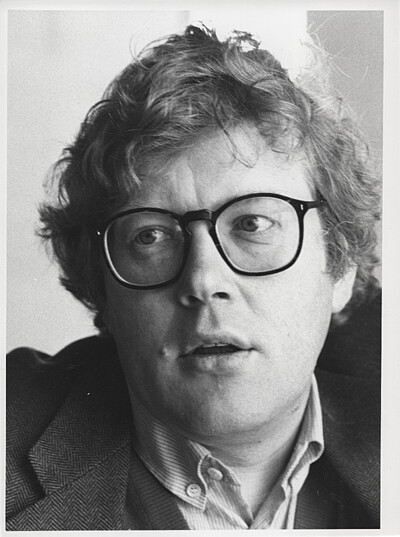
- documenta
- documenta archiv
“documenta was an attempt to create an enchanting terrain, as in a fairy tale. I read the Grimm fairy tales with such delight. Much rather than art history…” (Rudi Fuchs, 2015)
It is with great sadness that we have learned of the death of Rudi Fuchs. The artistic director of documenta 7 (1982) died on 25 October 2026 in Amsterdam, aged 84. Fuchs, who saw himself less as a curator than above all as an author and writer, will be remembered as a combative intellectual of great charm, whose exhibition practice always allowed for, and sought out, polar opposites and unexpected artistic encounters.
As director of the Van Abbemuseum in Eindhoven (1975–1987), founding director of the Castello di Rivoli near Turin (1984–1990), and director of the Gemeentemuseum Den Haag (1987–1992) and the Stedelijk Museum Amsterdam (1993–2003), Fuchs was for decades one of the formative figures of the Dutch and European museum landscape and one of the most authoritative voices in contemporary art of his generation.
From early on, Fuchs built bridges between the art worlds of Europe and the USA. His enthusiasm extended to Conceptual art on both sides of the Atlantic as well as to the emerging “wild” currents of postmodern painting. Accordingly, he oriented documenta 7, which he conceived together with the Artistic Board – Coosje van Bruggen, Germano Celant, Johannes Gachnang, and Gerhard Storck – towards (Western) Europe and (North) America, placing the classical genres of painting and sculpture at its center. The result was an exhibition of close neighborhoods and simultaneities, of contacts and overlaps, in which different styles and generations met. “My attitude is that artworks touch one another and deal with one another, just as people do on the street,” Fuchs later explained. During the exhibition, this principle became tangible, for instance, in the direct encounter on Kassel’s Friedrichsplatz of Joseph Beuys’s heaped basalt stelae, Daniel Buren’s pennant garlands accompanied by music, and Jörg Immendorff’s Brandenburg Gate.
Fuchs accepted without objection the rather provocative label “pluralist,” which an art dealer friend had pinned on him, and made it his stance. “The attempt of the documenta exhibition was […] to explain that Baselitz is good, also in comparison with Judd. That is important! At my innermost, I am a teacher and a storyteller.”
In this very spirit, Fuchs wrote a long letter to all participating artists in the run-up to the exhibition. In it, he describes documenta 7 as a literary narrative that unfolds in the mode of comparative juxtaposition:
“We will install the rooms in such a way that works by several artists can come together in each. There is no fixed pattern for this, since it is not meant to be a theoretical exhibition. (…) Who meets whom, and where: that is precisely our narrative, in which we want to report on our experiences, our encounters in the forest of the arts.
Warm regards
Rudi Fuchs”
documenta 7 left lasting traces in Kassel: The monumental pickaxe by Claes Oldenburg and Coosje van Bruggen still stands on the bank of the Fulda to this day, and Joseph Beuys’s project 7000 Oaks – City Forestation Instead of City Administration gave rise to a work that has shaped the city’s appearance as lastingly as hardly any other artwork.