- documenta
- documenta archiv
“Cathode-Ray Tubes Instead of Canvases” – under this motto, Wulf Herzogenrath appeared before television cameras in 1977 to introduce the still-emerging medium of video art at documenta 6 to a wider audience. Through his accessible television presentations, visionary works such as Global Groove by Nam June Paik reached viewers’ living rooms, transforming domestic spaces into temporary sites of artistic experience: a unique chapter in the history of documenta, contemporary art, and broadcasting alike. In retrospect, few phrases capture Herzogenrath’s lifelong commitment as a champion and mediator of media art more succinctly. Later, as director of Kunsthalle Bremen, he continued to demonstrate that contemporary art was “More Than Painting” – as the title of one of his books aptly declared.
Even during his tenure at Kölnischer Kunstverein, whose directorship he assumed in 1973 at the age of twenty-eight as the youngest museum director in the Federal Republic of Germany, Herzogenrath displayed an exceptional sensitivity to experimental artistic practices. He transformed the venerable institution into a focal point of the emerging Rhineland art scene: Nam June Paik presented his first retrospective there, while the group Kraftwerk attracted attention with its pioneering electronic music.
As a member of Manfred Schneckenburger’s curatorial team for documenta 6, Herzogenrath was responsible for the Video Section in the attic floor of the Fridericianum. There, he helped pave the way for a medium that had scarcely found a place in exhibitions and museums. Large-scale video installations by six women artists and seven male artists turned the improvised exhibition space beneath the roof into one of the most unusual venues of the exhibition. The video library he established invited visitors to borrow tapes by fifty artists from a counter and view them on cathode-ray televisions in specially designed viewing booths.
The success of the Video Section not only opened doors for the participating artists. Herzogenrath himself soon emerged as a leading candidate for the artistic direction of documenta and was invited back as a member of the core curatorial team for documenta 8 in 1987. This time, he focused on the integration of sound art and on new strategies for reaching broader audiences – advancing a vision of art that united seriousness with entertainment.
Throughout a career spanning more than fifty years, Herzogenrath remained one of the defining figures of Germany’s museum and art landscape. Since 2006, he had been a member of the Akademie der Künste in Berlin. As director of Kunsthalle Bremen from 1994 to 2011, he left a lasting mark on the museum’s collection through his curatorial vision and numerous significant acquisitions, including Nam June Paik’s Video Synthesizer (1969) and John Cage’s sound-and-light installation Essay, which he had previously presented at documenta in 1987.
Wulf Herzogenrath passed away in Berlin on 18 June at the age of eighty-two.
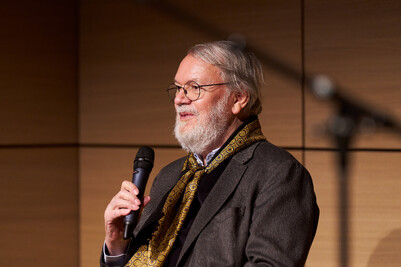
Birgitta Coers, director documenta archiv:
With the passing of Wulf Herzogenrath, documenta loses one of its most important curators, and the documenta archiv loses a vital historical voice and an unfailingly generous interlocutor. Since the 1960s, Herzogenrath helped bring international media art and sound art to a broad public. As recently as November last year, during the conference in Kassel jointly organized by documenta forum and documenta archiv, he spoke vividly about his collaborations with pioneers of sound installation such as Max Neuhaus and John Cage.
Our deepest sympathies go to his wife and his family.
Andreas Hoffmann, Managing Director, documenta und Museum Fridericianum gGmbH
Wulf Herzogenrath was one of those rare exceptional figures in the German museum landscape. When I first met him during his tenure as director of Kunsthalle Bremen, he was already regarded as one of the leading figures in the field. He had left a lasting mark on his own institution, contributed to documenta on two occasions, rediscovered public space in the divided city of Berlin during the years of reunification, and demonstrated in Cologne the unique potential of the Kunstverein as an institution. His openness and thoughtful judgment will be greatly missed in the art world.